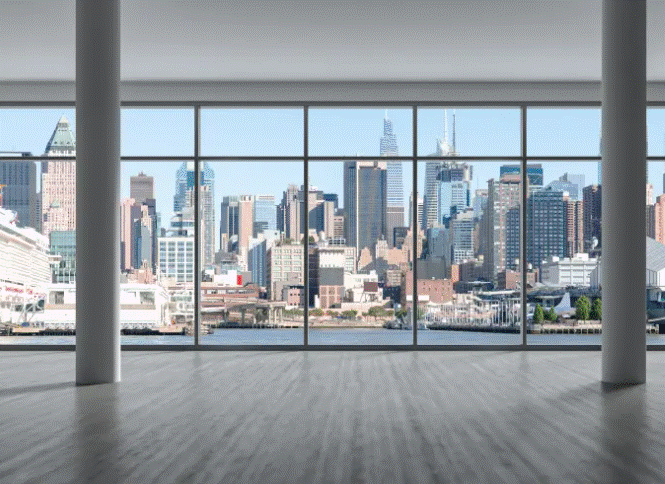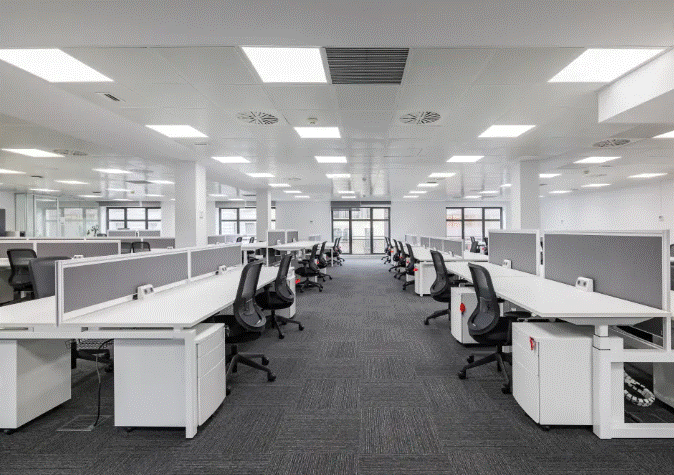
Manhattan’s offices just hit a new record high for emptiness. VideoFlow – stock.adobe.com
Big Apple office buildings have never been so empty.
While the peak era of remote work may feel long ago in the past, the number of vacant offices in Manhattan just hit a new record.
The borough’s office availability rate -– or, how much of that market is currently unfilled — hit 18.1% in the first quarter of 2024, the highest rate ever recorded. That’s according to a recent report by investment management company Colliers, Crain’s first reported.
In contrast, that number, which includes currently empty offices and those that will be empty in the very near future, was just 10% back in March 2020. The majority of the 8% vacancy increase that has occurred since then happened between 2020 and 2022.
Still, the rate has gone up even in the past 12 months, when it was 17.1%, and even last quarter, when it was 17.9%.
With the increase in availability, rent has also gone down slightly; 0.2% over the course of February.
In terms of leasing, the return to office is not currently going very well, according to the numbers. Pavel – stock.adobe.com
“We are still waiting for demand to catch up and surpass supply,” Colliers Executive Managing Director Franklin Wallach told Crain’s. “It’s still the early innings of 2024, and there are both a fair number of large leases pending and a large number of tenants in the market. But we also anticipate some large blocks of space to be added.”
Downtown is hurting the most, according to Colliers, with the Financial District the most forsaken of commercial markets.
Midtown has fared better, but the biggest divide in which offices will find tenants and which will remain derelict isn’t based on neighborhood, but age and offerings. Newer, more amenity-filled Class A buildings, as they’re called, are getting leased at a significantly faster clip.
For those banking on the death of remote work and the reclaiming of offices, there is one positive angle in Colliers’ findings, Crain’s notes: The rate at which offices are emptying out is, at least, not as fast as it was at the height of COVID-19.
Brooklyn’s tallest building is struggling to pay its skyscraping loans.
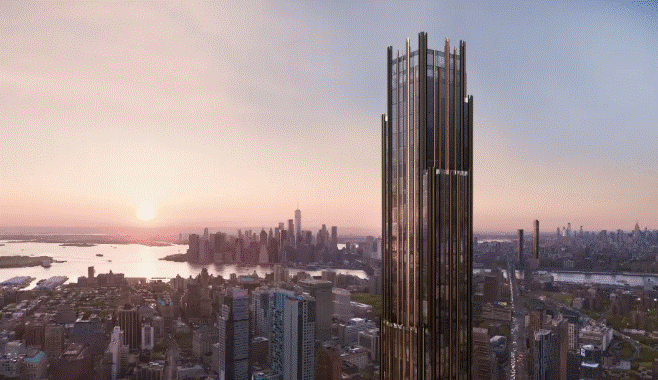
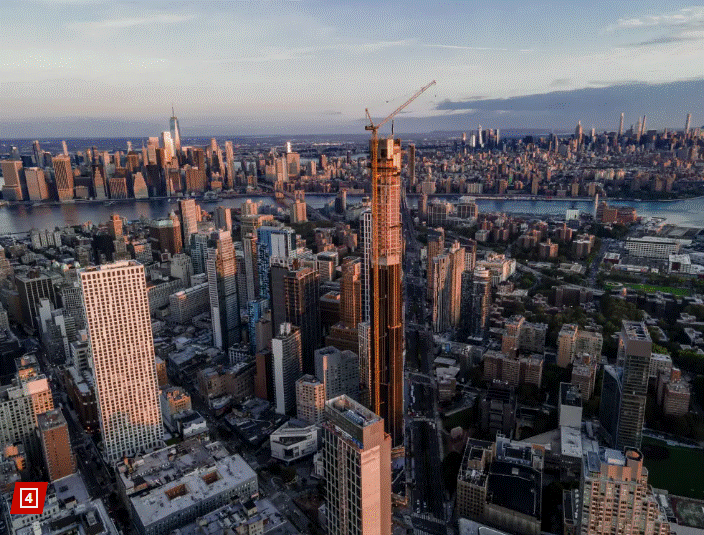
Michael Stern, the developer of 9 DeKalb Avenue’s 93-story The Brooklyn Tower, has defaulted on a $240 million mezzanine loan and now faces foreclosure, the Real Deal has reported.
A UCC foreclosure auction has been scheduled for Jun. 10 by Silverstein Capital Partners, which issued the loan in 2019, according to marketing materials from real estate company JLL.
The Brooklyn Tower, a 93-story structure located at 9 DeKalb Avenue, is the tallest building in the borough.
“9 DeKalb’s junior mezzanine, senior mezzanine and mortgage loans are in maturity default, and the junior mezzanine lender is enforcing its junior mezzanine loan remedies through a Uniform Commercial Code (UCC) sale process,” a Silverstein spokesperson confirmed to The Post.
“The junior mezzanine lender has engaged JLL to market the equity interests securing the junior mezzanine loan, and they will conduct a public auction after a marketing period.”
Stern’s JDS Development Group did not immediately return The Post’s request for comment.
It’s unclear what will become of the tower, which only opened to tenants last year.
The news comes just days after a 440-square-foot studio in the skyscraper sold for $905,000, making it the most expensive studio in borough history, 6sqft reported.
A video producer who lives across the street previously told The Post that the building looks like “the headquarters of an evil corporation in a superhero movie.”
The apartment, unit 72A, is more than 720 feet from the street below and features floor-to-ceiling windows, and in-unit Miele washer-dryer and European white oak flooring.
“This is an incredible milestone for Downtown Brooklyn. Our newest residents will be living at the highest elevations ever available in the borough,” said Stern, who attempted to sell part of the 1,000-foot-tall Downtown Brooklyn behemoth’s rental portion in early 2023.
At the time, he put its 398 rental apartments as well as the building’s amenities — including a pool, 50,000 square feet of retail and 77,000 square feet of workout facilities provided by the upscale chain LifeTime Fitness — on the market for an ambitious $500 million.
It’s unclear what will become of the tower, which only opened to tenants last year.
But a deal was never struck for the listing, which notably did not include the 93-story skyscraper’s 143 individual residential condominiums, and now the building’s fate is up in the air.
In addition to now having a reputation for financial trouble, the looming metallic supertall has also become known for its “evil vibes.”
A video producer who lives across the street previously told The Post that the building looks like “the headquarters of an evil corporation in a superhero movie.”
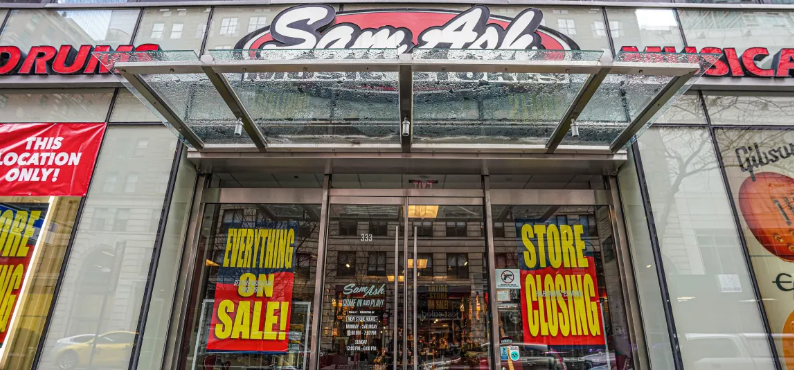
Sam Ash’s Midtown store is closing for good. Photo by Dean Moses
Sam Ash’s Midtown location is reportedly closing its doors for good. It was reported by w42st.com that the famed store, located at 333 W 34th St., would be closing down after a century of business in the neighborhood. Originally founded in 1924, the music chain originated in New York, with the first store opened by the Ash family in Brooklyn.
Photo by Dean Moses
The W 34th Street store is reportedly one of 18 stores that are closing across the country, which also reportedly includes Sam Ash’s Huntington Station location on Long Island and its Forest Hills location in Queens.
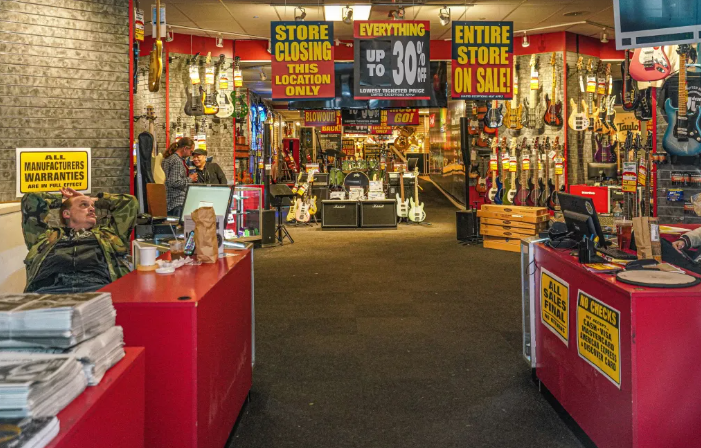
Liquidation signs appeared in the windows of the Midtown store, signaling sales and the store’s impending closure.
“For the last 100 years, Sam Ash Music has successfully adapted to meet the challenge of changing business conditions. As we look towards the next 100 years, the company must continue to adapt to ensure its continued success,” Sam Ash told amNewYork Metro in a statement. “Sam Ash Music remains committed to keeping a strong physical store footprint in the future while we continue growing our successful online sales offerings. As part of this restructuring, the company is closing several stores nationwide. This restructuring is emotionally tough, but we are confident these moves will make Sam Ash Music stronger as we continue serving the music community into the future, as we have for the past 100 years.”
Manhattan Real Estate Tracker visited the store yesterday and most items are now 10% with no returns accepted.
Manhattan Real Estate Tracker has learned that Avi Hiaeve, the founder and CEO of the luxury timepiece and jewelry firm Avi & Co., purchased the former Playboy Club building at 5 East 59th Street at a foreclosure auction. The bid was approximately $26.7 million. The previous investors had purchased the property for $85 million.
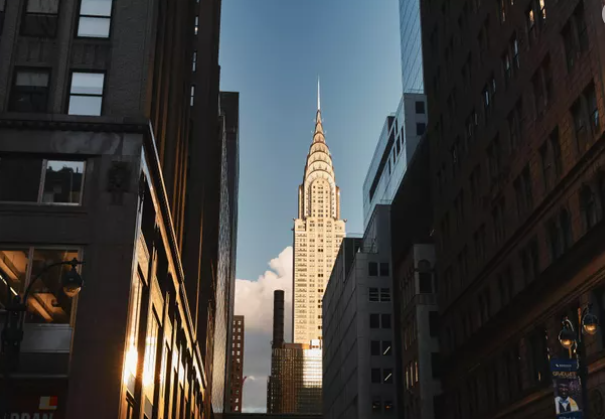
The Chrysler Building is attempting to reposition itself by marketing to high-end retail tenants.
The iconic Chrysler Building has signed its first tenant following a retail makeover that aims to bring an air of modern luxury into the challenged art deco landmark.
WatchHouse, a British coffee shop that recently opened its first U.S. store at 660 Fifth Ave., will open its second location at the base of the Chrysler Building. It signed a lease for 2K SF on 43rd Street, across from an entrance to Grand Central Terminal.
Retail by Mona CEO Brandon Singer, who led broker teams that represented the tenant and landlord RFR, said the lease reflects the vision for the building’s retail.
“It’s creating a destination for retail that is a little bit outside of the box, given the amazing asset,” Singer told Bisnow. “With all the dense office buildings in this area, this will help the people coming back to work. Give them an experience that they may not have had in the past.”
As tenants opt for amenity-rich, Class-A towers, owners of historic buildings like the Chrysler Building are attempting to find a role for their properties to play in a remote work world.
Singer’s team is marketing several spaces on the 1,046-foot-tower’s ground floor, in addition to storefronts on the arcade level, which totals 30K SF alone. RFR is also considering adding retail use to the second floor.
It is reinventing the Cloud Club lounge on the 61st and 62nd floors as part of a renovation that RFR co-founder Aby Rosen told Bloomberg in 2020 would cost at least $200M.
“We wanted to create something nice — food, wine, dry cleaning, shavers, hairdressers — so tenants have a reason to stay longer instead of running out,” Rosen told Bloomberg at the time.
Singer declined to provide further details on the building’s upgrades. RFR declined to comment.
The Chrysler Building previously housed retail tenants that served daily Midtown commuters, including a barbershop, a shoeshine, a dry cleaner, a locksmith and an optometrist — but all of them vacated in 2020. In its next chapter, the building will focus on higher-end tenants that could appeal to shoppers outside of the 9-to-5 work schedule, Singer said.
Most recently, the building, once the world’s tallest, has been caught in the collapse of Austrian property company Signa. The firm, founded by investor René Benko, filed for insolvency in November, and it is looking to unload its 50% stake in the skyscraper.
Rosen had been in talks to renegotiate the building’s long-term ground lease with The Cooper Union since he and Signa acquired the leasehold in 2019. Signa’s insolvency complicated those efforts, and RFR is on the hook for more than $31.5M in annual ground rent payments, the New York Post reported in November.
The Chrysler Building’s retail repositioning is similar to that of its rival Empire State Building. Empire State ownership added a three-story Starbucks Reserve store to its retail base in 2022. In 2019, it debuted a $165M redevelopment, which added a museum and made improvements to its observatory.
Empire State Realty Trust, the owner of the Empire State Building, said in its annual report that the observatory generated $129.4M in revenue, a sixth of the REIT’s total from last year. The 91K SF of retail in that building was 76.4% leased at the end of 2023.
Mayor Eric Adams is set to use his State of the City address Wednesday to unveil a new push to use a slew of city-owned properties for affordable housing projects, The Post has learned.
The new plan will make use of public sites across the Big Apple in a bid to advance a total of 24 housing projects by the end of the year, according to an early snippet of Hizzoner’s speech obtained by The Post.
The ambitious project — dubbed “24 in 24” — will create or preserve more than 12,000 affordable homes scattered across the five boroughs, according to the mayor’s office.
“Our ’24 in 24’ plan to create and preserve affordable housing on 24 publicly-owned sites is another example of how we’re doing everything within our control to deliver housing and relief to New Yorkers when they need it most,” Adams said in a statement to The Post.
“Investments like these, once again, deliver on the vision we laid out to protect public safety, rebuild our economy, and make this city more livable for working-class New Yorkers.”
The specific plans for each property weren’t immediately available, though the Adams administration said further details on the projects and sites would be released in the coming months.
Among the locations already tipped to be part of the project is the Grand Concourse Library on 173rd Street in the Bronx and a Staten Island site located on the corner of Canal and Front streets.
The new plan will make use of public sites across the Big Apple in a bid to advance a total of 24 housing projects by the end of the year. Google Maps
At least three of the sites slated to be announced in Adams’ initial plan later Wednesday have already been floated as affordable housing developments, including 388 Hudson St. in the Greenwich Village.
In September, the city’s Department of Housing Preservation and Development had unveiled four potential renderings of the soaring building, which could rise up to 355 feet at the city-owned lot — angering some residents in the quaint neighborhood.
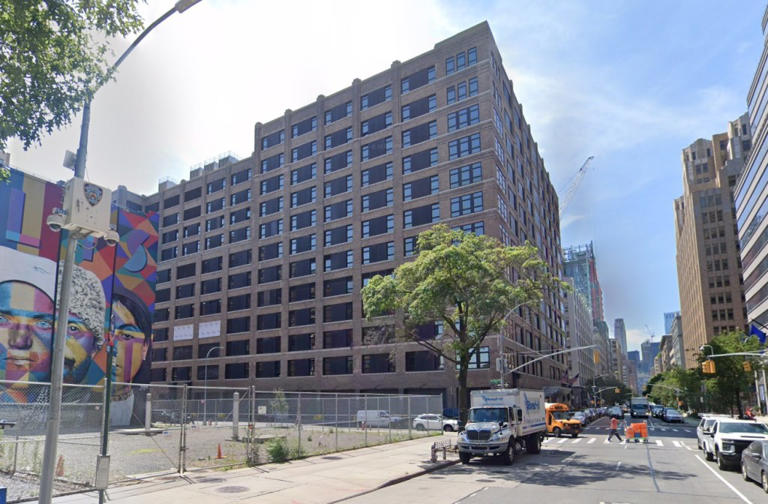
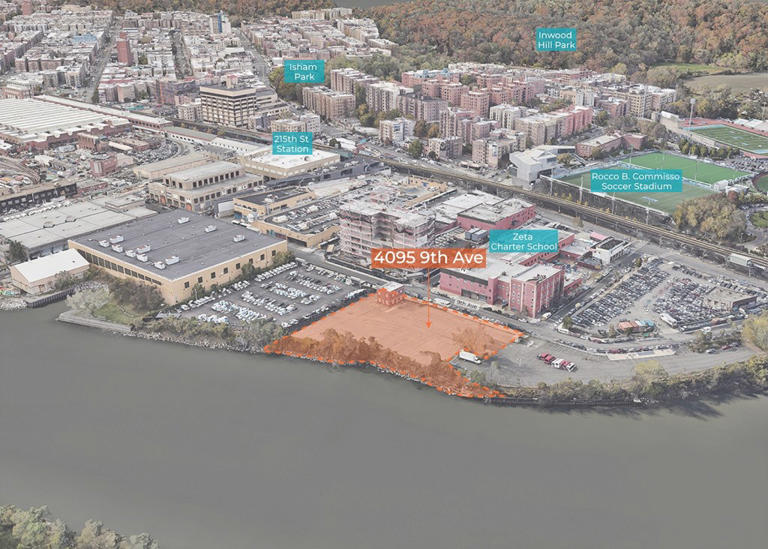
Two other lots in Queens — including the Hunters Point South Parcel E and a parking lot on Ninth Avenue in Inwood — are also HPD-led projects that are among the initial sites included in the mayor’s new plan.
The ambitious project — dubbed “24 in 24” — will create or preserve more than 12,000 affordable homes scattered across the five boroughs, according to the mayor’s office. nyc.gov. “While we advocate for action in Albany this session and advance our historic ‘City of Yes’ proposal, our administration is tackling the housing and affordability crisis with urgency,” the mayor said his statement.
His plan will coordinate efforts from the HPD, the New York City Housing Authority, the New York City Economic Development Corporation and the New York Public Library.
News of Adams’ plan comes just days after the city agreed to slash its practice of giving residents first dibs on new affordable apartments in their neighborhoods after settling a landmark federal lawsuit that claimed the Big Apple’s housing lottery promoted segregation.
Under the agreement approved Monday by a Manhattan federal judge, the city will soon only set aside 20% of units — down from the current 50% — for those locals vying to win the housing lottery in their own neighborhoods.
In addition to his new housing plan, Adams is expected to use his third State of the City address to touch on crime, jobs and the migrant crisis.
He is set to deliver the remarks at the Hostos Community College in The Bronx from 12:30 p.m.
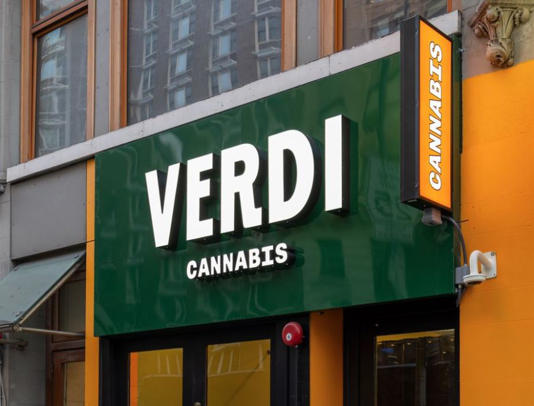
Verdi Cannabis, the first legal recreational weed dispensary in Chelsea, will officially open on Friday.
Verdi will be located at 158 W 23rd St., between Sixth and Seventh avenues in Manhattan.
Father-and-son duo Mitchell and Ellis Soodak are the owners of Verdi, which will sell state-regulated marijuana products.
“Our dispensary will stand out because of our knowledgeable and educated budtenders sell tested and regulated cannabis, as well as providing a safer option for consumers,” Ellis Soodak said.
Verdi will be open from 9 a.m. to 11 p.m., Monday to Saturday, and from 10 a.m. to 10 p.m. on Sundays.
A grand opening ceremony will be held at 11 a.m. on Friday.
“Verdi represents a new era for cannabis enthusiasts in Chelsea,” Ellis Soodak said. “Our goal is for Verdi to be more than just a dispensary as we aim to be a critically important community alternative to the illicit cannabis establishments that have saturated the Chelsea area.”
The Travel Agency: A Cannabis Store is in line to be the first cannabis retail brand in New York State with multiple locations, as the legal-cannabis business starts gaining a foothold over illegal shops.
Separately, Curaleaf Holdings Inc. said it received special-use approval to open its first New York adult-use store, which will be located in Newburgh, a city about 70 miles north of New York City.
Curaleaf planned to kick off delivery service from the location this past weekend, with a soft opening by the end of January, pending state approval. New York-based Curaleaf has been providing cannabis to the medical market since 2017.
Curaleaf’s stock rose 7% on Friday. The shares are up by 23.5% in the past year, compared to a 37.4% rise by the Nasdaq
New York State’s legal-cannabis business is speeding up after a slow start due to some headwinds, including the cost of real estate and competition from literally thousands of unlicensed stores hawking unregulated cannabis products.
New York’s licensed-cannabis market generated only $150 million in sales in its first year of operation in 2023, less than the $274 million generated by the smaller state of Connecticut, which also kicked off adult-use sales about a year ago.
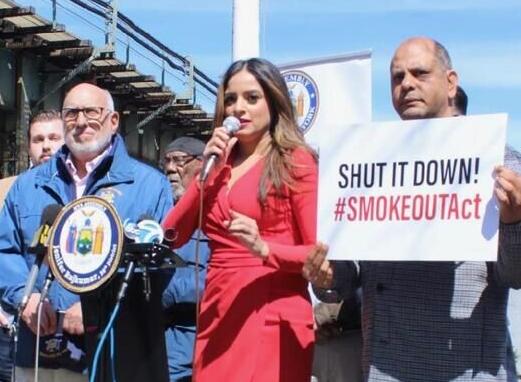
Gov. Kathy Hochul plans to propose legislation to crack down further on unlicensed cannabis shops. She’s also including a cannabis potency tax repeal and replacing it with a weight-based tax to “ease tax compliance” for distributors.
Hochul’s proposal comes mirrors a proposal in the state legislature to scrap the potency tax in favor of a 9% wholesale excise tax.
The idea is that cutting some cannabis taxes may lower the cost at the cash register and make legal pot more competitive with unregulated pot being sold in unlicensed stores.
Paul Yau, founder of the Travel Agency, said the effort by the state to cut taxes and close down unlicensed shops marks a positive move for the business.
“We 100% support trying to get rid of illicit stores,” Yau told MarketWatch, noting that Hochul made “having safe, tested, clean products” a priority by including a mention in her state-of-the-state address.
Cannabis companies have been slow to open for a variety of reasons. If a major bank holds a mortgage on a property, it may not allow a cannabis business to be a tenant because pot remains illegal under federal law.
Cannabis company operating expenses remain high because of these and other obstacles, he said.
Meanwhile, The Travel Agency is readying its second store at 118-122 Flatbush Avenue, near the Barclays Center in downtown Brooklyn, close to major public-transportation routes.
“We’re looking to make this the premier dispensary in Brooklyn,” Yau said.
The stores will initially open as a pop-up with 3,500 square feet, with 60 full-time and part-time workers, and then expand to 4,800 feet.
While adult-use cannabis has been approved since 2021, legal shops have been slow to gear up as the state awarded its first licenses to non-profits and people affected by the War on Drugs.
Travel Agency runs its two stores for license holders The Doe Fund in Manhattan and GMDSS LLC in Brooklyn.
The Travel Agency’s flagship store opened a year ago under the name Union Square Travel Agency just south of Union Square in Manhattan as the third overall retail cannabis shop in the state.
Now, the Travel Agency name will be used for both the original Union Square store and its downtown Brooklyn location, under a re-branding effort.
In November, the state also officially sanctioned its existing medical-use licensees to take part in the recreational market.
Those companies include Columbia Care, Curaleaf Holdings Inc., Etain, Nycanna LLC, PharmaCann and Valley Agriceuticals LLC
Companies with an existing presence in the state’s medical program include Curaleaf Holdings, RIV Capital Inc. Green Thumb Industries Inc. and privately held PharmaCann.
From NYPost.com, By Aneeta Bhole, Published Dec. 29, 2023
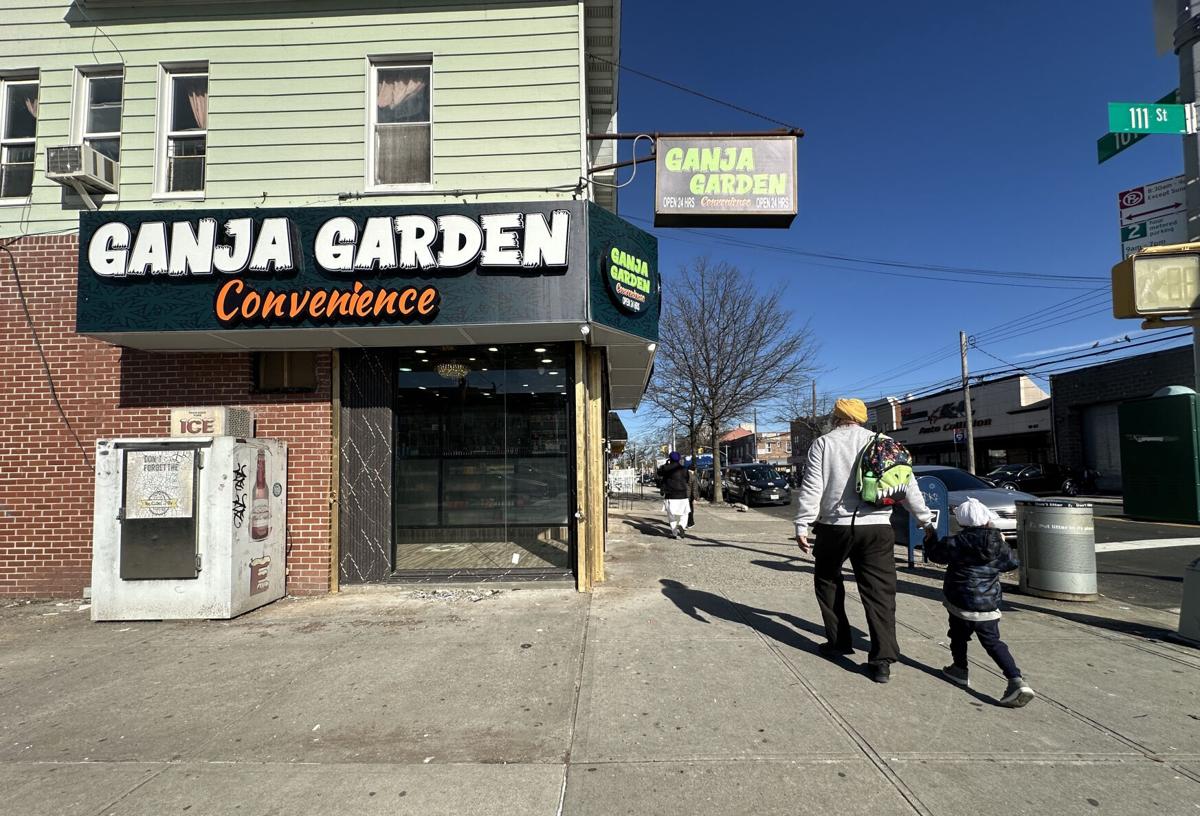
New York pot regulators bragged Friday about the financial success of the legal cannabis industry in 2023 — but made little mention of the millions in taxes being lost to the illegal marijuana stores spreading across the landscape like weeds.
The Office of Cannabis Management’s year end statement was filled with superlatives describing a blooming industry that brought in some $16.5 million in tax revenue on the sales of some 3.5 million pot products sold.
“2023 was a year of growth for New York cannabis and we know 2024 will be even more significant,” said John Kagia, the office’s Director of Policy, which said there was some $150 million in total legal sales this year.
The office, however, couldn’t put a price tag on how much was being sold at the estimated 1,500 illegal vendors operating on nearly every commercial block in the city and elsewhere in the state — which officials have complained have been stealing business from the measly 40 officially licensed shop currently approved in New York state.
The statement did say that they were cracking down on the illegal shops, and that more than 11,600 pounds of illicit products, with an estimated street value of more than $56 million, has been seized.
NY pot regulators boast $150M in legal cannabis sales as illegal marijuana stores rob state of millions in taxes (Provided by New York Post).
New York pot regulators bragged Friday about the financial success of the legal cannabis industry in 2023 — but made little mention of the millions in taxes being lost to illegal marijuana stores. Helayne Seidman
But when asked for details about the total size of the illegal industry, operating in plain sight, the state could provide no data.
Vendors setting up unlicensed shops mostly do business in cash and don’t pay cannabis taxes that licensed marijuana dispensary stores are required to do.
A spokesperson for the cannabis office said they “do not have firm or reliable estimates on total number of unlicensed shops.”
The Office of Cannabis Management’s year end statement was filled with superlatives describing a blooming industry that brought in some $16.5 million in tax revenue on the sales of some 3.5 million pot products sold (Getty Images).
The state said that close to 7,000 licenses were applied for processors, cultivation, distribution, microbusiness and retail dispensary this year and Kagia noted demand was high and is expected to grow.
“And now, with the Office poised to issue hundreds more adult use retail licenses, there’s tremendous excitement as consumers across the state are poised to gain access to this exciting market,” he said.
Just in New York over 500 strains have been made available to the exploding market with names such as Gas Face, Blueberry Muffin, and Sour Diesel.
2023 was a year of growth for New York cannabis and we know 2024 will be even more significant,” said John Kagia, the office’s Director of Policy, which said there was some $150 million in total legal sales this year (Matthew McDermott).
“There are also products available across the price spectrum, from low-cost value brands to ultra-premium product,” Kagia added.
“Furthermore, it’s not just flower products that are selling. Non-flower products, from infused gummies and innovative beverages like cannabis infused apple cider, to strain-specific vaporizers and high potency tinctures, ensure that there is something for everyone in this market.”
The University of Toronto’s analysis measured the number of visitors, including shoppers and tourists, plus residents and workers in the so-called “downtown” or business/tourist districts in major cities in the United States and Canada.
Lower Manhattan, including the Wall Street financial district, and Midtown, featuring Times Square, were considered the Big Apple’s “downtown” district for the study.
Researchers measured foot traffic through mobile phone presence, comparing March to mid-June in 2023 to the same period in 2019.
New York’s 66% recovery rate ranked 54th out of 66 cities surveyed.
Supermarket magnate and radio host John Catsimatidis told The Post on Sunday that workers need to return to the office.
“I’m very concerned about New York City,” he said. “Right now, Manhattan has one nail in the coffin.
New York City came in 54th place for downtown recovery out of 66 cities.
“If you impose congestion pricing to enter the business district, you’ll put two nails in the coffin,” he said, referring to the transit plan to charge drivers in certain city zones to try to discourage vehicles.
“You see nobody walking after dark.”
Democratic city Councilman Keith Powers, who represents Midtown East and West and Times Square, said the city needs to create more housing in the area to make up for the loss of office space and workers.
“We’ve made steady progress in getting people back to Midtown, but we need to be forward-thinking about the future and recognize changes to the work place,” he said. “One of our strategies is rezoning Midtown South to incentivize more housing and create a 24/7 neighborhood.”
Las Vegas ranked first, having 103% of the foot traffic — or 3% more — from pre-pandemic. The gambling mecca was the only city to have more foot traffic than before the COVID-19 outbreak.
A researcher for the study suggested the societal shift to remote office work has caused a dramatic drop in foot traffic in Gotham’s business districts.
“We’ve been tracking since early 2022, and New York was an early comeback story – but then stalled,” said Karen Chapple, director of the University of Toronto’s School of Cities, to The Post.
A researcher says that New York was an early comeback story after the lockdown until it stalled.
The researcher did note that unlike earlier studies, her project excluded Hudson Yards because it is not traditionally considered part of Midtown.
Other major cities that recovered most or considerably more foot traffic from the pre-pandemic period compared to the Big Apple include Miami (92%), Nashville (88%), Atlanta (85%), Los Angeles (83%) and San Diego (80%).
As with New York, there are other cities that have struggled to recover the pre-pandemic density in their central business district.
Chicago’s foot traffic was just 61% of what it was before the pandemic.
The recovery rate for Seattle and Minneapolis was under 60%.
Other non-downtown tourist areas in New York have seen a stronger increase in traffice.
High-tech San Francisco’s recovery rate was nearly identical to New York City’s — or 67%.
But the Partnership for the City Of New York, a major business advocacy group, questioned the accuracy of the University of Toronto’s data, citing more recent reports showing a stronger recovery in Manhattan’s key commerce and tourism districts.
Pedestrian foot traffic in Times Square averaged 285,000 in the last week of October 2023, or 80% of the pre-pandemic count of 356,000 during the equivalent week in 2019, it said.
In Downtown Brooklyn, monthly foot traffic reached 75% of pre-pandemic levels in June 2023.
“A lot of our pre-COVID foot traffic involved tourists, and international tourism is still down. We also have by far the densest concentration of office workers, so the hybrid work week has had a bigger impact here, with average weekday presence in the office [having] dropped from 80 % pre-pandemic to just under 60% today,” said Partnership CEO Kathryn Wylde.
Wylde also noted such studies don’t take into account the increase in foot traffic where many office employees now work and shop.
“On the other hand, the city has business districts across the five boroughs which have likely experienced an uptick in foot traffic as a result of work from home,” she said. “So I don’t think [the Big Apple’s] comparison with smaller cities with a single ‘downtown’ is a fair one.”
Broadway sales and attendance were at 85% and 81% of pre-pandemic levels, respectively, during the last week of October, the Partnership added.
Wylde pointed to other promising data points indicating a stronger recovery, noting that New York City’s regional airports had their busiest month in history, with more than 13.3 million passengers served in August and adding that the 192nd new business opened in Times Square in October, surpassing the 179 businesses that closed during the pandemic.