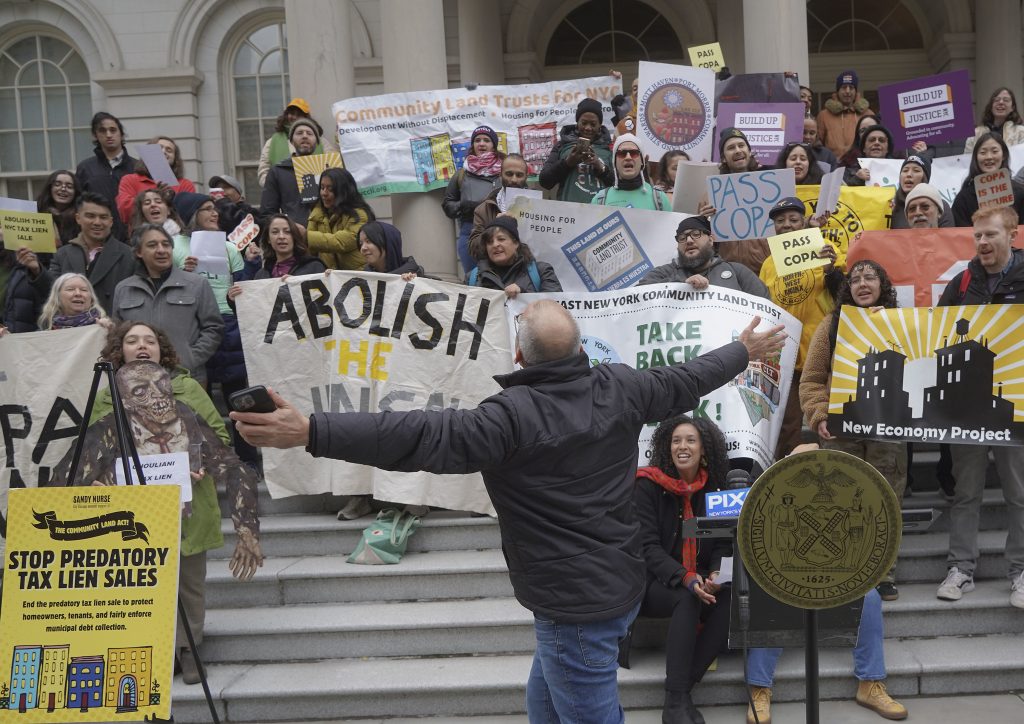
COPA May be Revived by NYC Council
By Manhattan Real Estate Tracker, May 20, 2026
The Community Opportunity to Purchase Act (COPA) may be coming back in a modified form. According to the NYC Commununity Land Initiative, “The Community Opportunity to Purchase Act (COPA) is a proven tool to expand and preserve the supply of affordable housing and combat displacement. NYC Int. 902 is modeled on successful Opportunity to Purchase legislation implemented in San Francisco, Washington, D.C., and other jurisdictions and co-sponsored by 32 City Council Members. More than 120 community, tenant, and affordable housing organizations and coalitions – including the NYC Community Land
Initiative (NYCCLI), ANHD, and Housing Justice for All – support COPA.”
NYCCLI states that when a landlord sells a multifamily property, COPA offers eligible organizations, such as community land trusts (CLTs), the first opportunity to bid. In particular, Int. 902 establishes a procedure and deadline for organizations to submit competitive offers:
1. Before listing an apartment building for sale, a landlord is required to give the NYC Department of Housing Preservation and Development (HPD) basic information on the building’s finances and rent roll.
2. Qualified nonprofits have 120 days to submit a competitive bid for the facility and 60 days to notify HPD and the owner of their intention to buy.
3. The landlord may sell the property on the open market if a nonprofit does not indicate that they intend to buy it or if their offer is turned down.
Months after the Council failed to override former Mayor Eric Adams’ veto, Sandy Nurse, a member of the City Council, introduced a revised version of the bill that would give city-approved nonprofits (as well as joint ventures between nonprofits and for-profit developers) the first opportunity to purchase certain distressed multifamily buildings and properties with expiring affordability restrictions. Ms. Nurse described the most recent version as “stronger and more targeted,” with shorter deadlines and more stringent eligibility standards. Buildings with four or more units that satisfy at least one of several distress criteria—such as an average of three or more hazardous violations per unit per year (up from one in the previous version), inclusion in the city’s Alternative Enforcement Program, in rem foreclosure status, unresolved underlying-condition violations lasting at least a year, or a recent denial of a certification of no harassment—would be covered by the bill.
Although the amended law exempts 421a properties and concentrates on smaller rent-regulated assets, it would also encompass buildings with fewer than 100 units that are subject to expiration affordability constraints within two years. Nurse claimed that cutting the deadline by 15 days would have little practical impact, particularly since the bill permits organizations to sue owners for suspected noncompliance, which might cause months-long delays in purchases. One significant modification was that owners would no longer be subject to vague civil fines imposed by judges for breaking the law. Instead, owners who neglect to give the necessary notice of intent to sell would be subject to fines of up to 15% of the sale price. The Mamdani administration supports the bill.